

Hull Identification Numbers for Boat Owners - Ver. 4
Hull Identification Number: In 1972 the Federal Boat Safety Act became law, and to implement it the U. S. Coast Guard was required to propose regulations for the safe construction of boats. As a way to determine if a boat was in compliance with the new regulations, a HIN was required on each boat. Every recreational boat manufactured, imported, or built in the USA, and Canada, and many other countries, must have a Hull Identification Number (HIN). This is a unique number identifying each boat, in much the same way that every automobile has a Vehicle Identification Number (VIN). The US and Canadian rules for HINs are the same and the European Economic Community (EU) has adopted very similar rules. But some boat owners get confused about HINs, especially on older boats that weren’t required to have them, home built boats, and imported boats.
Manufacturer Identification Code: The HIN identifies the manufacturer and when the boat was made. It is a twelve digit number. The first three letters (in some older MICs there may be a number) are the Manufacturer Identification Code (MIC) and the last four numbers show the date of certification. You can look up a MIC here. https://www.uscgboating.org/content/manufacturers-identification.php
The date of certification is the date the manufacturer certifies that the boat meets all the regulations that the particular boat has to meet. But this kind of legal jargon is confusing to most people, so the last four digits, to most people, indicate when the boat was built. Look here for the US Coast Guard version of HIN 101. http://www.uscgboating.org/library/boating-safety-circulars/BSC70.pdf#basics
State Requirements: The regulations were intended to apply to boat builders and manufacturers, not boat owners. The regulations have changed and now require states to assign HINs to all boats that do not have a valid HIN. Prior to this the state could choose to not assign an HIN to old boats. Now all the states include the HIN in their registration process and require a HIN on every boat, even old, home made, and imported boats. States are now also required to verify that HINs on imported boats are valid.
Each state is assigned its own MIC to use when assigning a HIN. State MICs all start with the state abbreviation, such as NY, NJ, WN, FL, and end in Z. The abbreviations used are not the US Postal Service abbreviations. They are the abbreviations used for boat registrations, established in 1958. For example, a boat given a HIN by Washington would start with WNZ.
Stolen Boats: Complicating the issue, the HIN has become a tool for law enforcement agencies to detect stolen boats, insurance fraud, and other crimes. Insurance companies also use the HIN to identify specific boats. It is important for all boats, old and new alike, to have a valid HIN.
Normally, a number is assigned by the builder or manufacturer. They keep a list of who the boats were sold to, by HIN. This is an effective tool for defect recalls, and for law enforcement checking bogus HINs.
So where does the boat owner come in? This is not normally an issue with a brand new boat. Most boats come with the HIN on the transom, or at or near the stern on boats with no transom.
Current HINs since 1984
A HIN looks like this:
ABC12345L409
So, what does it all mean? ABC is the MIC.
The next five characters are anything the builder wants to assign. It can be 12345, or 00001, or 0000A, or 32001. Whatever they want to put in there except: O, I or Q. These characters look too much like zeros or ones. Some manufacturers use a sort of code in this area. For instance, if they build a thirty footer and this is the first one then they would use 30001. Others just assign consecutive numbers, 00001, 00002, 00003, etc.
The ninth character identifies the month when the boat was certified (or built) as shown in the chart below. If it's built in May the ninth character would be an E.
It works like this:
|
A: January |
G: July |
|
B: February |
H: August |
|
C: March |
I: September (yes it's an I, but it's ok) |
|
D: April |
J: October |
|
E: May |
K: November |
|
F: June |
L: December |
The tenth character is the last digit of the year when the boat was certified (or built). For example, if the year is 1997 then the tenth character would be a 7, or if it is the year 2009, it would be a nine. For a 2023 boat it would be a 3.
Certification Labels: The date of certification is the date the manufacturer certifies that the boat meets all the regulations that the particular boat has to meet. What this means is: a manufacturer is required to certify, by placing a label on the boat, that it complies with all the regulations that apply to that boat. The label says:
This boat complies with US Coast Guard Safety Standards in effect on the date of certification.
This label is usually on the capacity label, for boats that have one, or at or near the helm station as a separate label for boats not required to have a capacity label. The date of certification can be anytime between when the boat was begun until the date it leaves the place of build. The law says the date of certification, and also the HIN, must be on the boat before it is sold, offered for sale or entered into interstate commerce.
Model Year: What does this have to do with model year? Since the ninth and tenth characters are the date of certification, the model year must agree with that date.
The last two characters are the model year. In the USA the model year is defined in the Code of Federal regulations; Effective model year 2019
"On February 8, 2016 Congress included a provision within the Coast Guard Authorization Act of 2015 that moved the start of the recreational boat model year from August 1st to June 1st , extending through July 31st of the following year. This change
allows for a 14-month model year window for recreational boats, and the definition of model year can now be found in Title 46 U.S. Code, Chapter 4302. " USCG Boating Safety Circular #91 Dated Fall 2018
46 U.S. Code § 4302 - Regulations
(e)
(1)Under this section, a model year for
recreational vessels and associated equipment shall, except as provided in paragraph (2)—
(A) begin on June 1 of a year and end on July 31 of the following year; and
(B) be designated by the year in which it ends.
(2) Upon the request of a recreational vessel manufacturer to which this chapter applies, the Secretary may alter a model year for a model of recreational vessel of the manufacturer and associated equipment, by no more than 6 months from the model year described in paragraph (1).
Prior to this model year was defined as:
33 CFR 181.3 Model year means the period beginning August 1 of any year and ending on July 31 of the
following year. Each Model year is designated by the year in which it ends.
For a time, the U. S. Coast Guard was not strictly enforcing the month portion of the definition of the model year. A builder could begin a model year in the month they wanted but it still could not differ from the year it was built. Most manufacturers started their model year in August, but some used June or July. One even started in May. For instance, a boat that was built between June, 1989 and May 31, 1990, would have been labeled a 1990 model. But their model year began on June 1 and ended on May 31 of the next year.
The USCG always enforced the year portion of the model year definition. That is the model year on the HIN must fall within the year the model year ends. “Each Model year is designated by the year in which it ends.”
In 2009 the USCG ruled that the model year would be enforced as written. The model year must begin and end in accordance with the regulation. If the boat is a 2000 model year it shouldn’t say 1997 or if a boat is a 1997 model year it should not have a model year of 2000. If it was built between August 1 of 2000, and July 31 of 2001, then it is a 2001 model year. Now if it is a 2020 model year the model year must start on June 1 of 2019 and end on July 31 2020. Yes, this is a 14 month model year. If the model year differs from the date of certification, every time someone tries to register that boat, the state will flag it for checking. The cops will come and start asking nosy questions. Also, the owner will have a difficult time insuring the boat. The insurance agent will suspect some sort of fraud if the model year is significantly different from the actual year built.
The exception is a boat that takes longer than a year to build. Since this is really the date of certification, then the HIN does not have to be put on until the boat is finished and ready to leave the place of build. In a large vessel this could be several years from the start of construction. So, even though they started in 2019, if the boat was not finished until 2023, then it could be a 2022 model year or even a 2023 if it was finished after June 1, 2022.
Country Codes: There have been some additions to the HIN since 1984. A builder can add info before and after the number. For instance, many imported boats have a country code before the number.
US - ABC12345L409
This is HIN for a boat built in the USA. If the two letters were CA it would be Canada. The International Standards Organization (ISO) publishes a list of country codes. Below is a photo of a Canadian HIN.
https://en.wikipedia.org/wiki/List_of_ISO_3166_country_codes
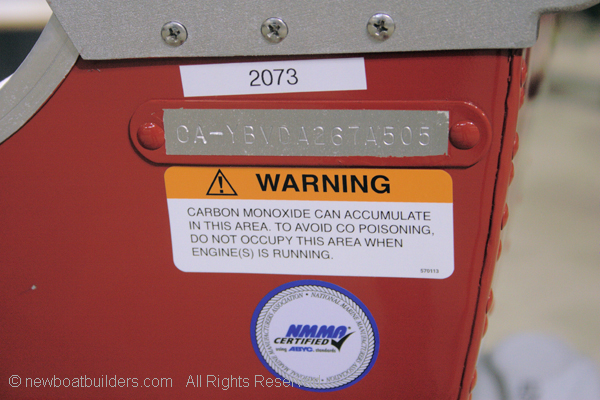
Additionally, they can put up to five characters after the HIN.
US - ABC12345L495 - H3266
It is rare to see a 17 or 19 character HIN but they do exist. The last five characters are a description of the boat and especially useful to law enforcement in tracking stolen boats. The International Association of Marine Investigators has been trying for years to get the last five digits adopted by the US and the EU. However, the Coast Guard has decided to no longer pursue the 17 character HIN.
HINs Prior to 1984: Alternative HINs.
Suppose you buy a boat that was built between 1972 and 1984, and it has an HIN, but that HIN doesn’t look like the current format? There were two separate formats that manufacturers could use during that period.The first looked like this:
ABC123451075
ABC = Manufacturer Identification Code
12345 = Manufacturer assigned serial number
1075 = 10, the month of certification, 75, the Year of certification
Or
ABC12345M75J
ABC = Manufacturer Identification Code
12345 = Manufacturer assigned serial number
M75J = Model year 75. J = month of certification (starting the year before, in this case 1974.)
|
A = Aug |
B = Sept |
C = Oct |
D = Nov |
E = Dec |
F = Jan |
|
G = Feb |
H = Mar |
I = Apr |
J = May |
K = Jnne |
L = July |
This was far too confusing so in 1984 the USCG adopted the current system as explained earlier.
Boats without an HIN:
What if you buy an old boat made before 1972, and it doesn’t have a HIN, or it was home built? If you bought the boat, make sure you get a valid bill of sale from the seller. If they have previously registered the boat, you should also get the old registration. In states that Title boats you should get the Title transferred as well.
Home Built Boats: If you built the boat, you will not have any of these. The state will ask you to fill out a form to attest that either you built the boat, or that it was built prior to 1972. They may also ask for a Manufacturer’s Statement of Origin (MSO), or a Manufacturer’s Certificate of Origin (MCO). Old boats or home built boats simply do not have these documents. Only new or factory built boats have them. Some states also require you to provide sales receipts for material and equipment to determine the value of the boat for tax purposes.
They may also require someone to look at the boat and verify it exists. This may mean bringing the boat on a trailer to their office, or if it is a large non-trailerable boat, having a law enforcement officer come to look at the boat.
State Issued HINs: They will then assign a HIN to the boat. You will have to put the HIN on the boat in two places. The requirement is for the HIN to be placed on the upper right corner of the transom, or if no transom, at or near the stern on the right side below the gunwale. A duplicate needs to be put in a concealed location. Remember where this is. If you ever sell the boat you will need to pass this on to the next owner.
The HIN must be “permanently affixed”. This means put on in such a way that any efforts to remove or change it will be obvious. It can be burned, etched, carved, or stamped. You can put it on a plate or label as long as the plate or label cannot be removed.
Registration rules vary from state to state, so contact the state’s Boating Law Administrator. https://www.nasbla.org/about-nasbla/boating-contacts
See also Vintage Boats for more about boats without an HIN.
Imported Boats:
To make this even more muddied, imported boats are now entering the country with HINs that appear to be valid. They look just like US or Canadian HINs and they are valid in the country of origin, but not in the USA. All Canadian HINs are valid in the US and vice versa. . The US and Canada have a shared MIC code database.
Why aren’t most foreign HINS valid? It goes back to the Manufaccturers Identification Code. The International Standards Organization (ISO) has adopted their own MIC assignment system. The EU incorporated this in their code called the Recreational Craft Directive. Each EU country is now assigning MICs to their boat manufacturers. Many of these are identical to MICs assigned by the US and Canada. A boat with a MIC of ABC may have been made in any of several dozen countries. In other countries that also follow the ISO rules, such as Australia and New Zealand, MICs are being assigned to identify their boat builders. There is no international database of boat manufacturers to verify a MIC of an imported boat.
The rule in the US is that the importer is supposed to get a MIC from the US Coast Guard and assign valid HINs to the boats. Unfortunately, this is often not done and there are thousands of imported boats sold each year in the US with invalid HINs. This usually becomes a problem when the boat is registered with a state. States are now required by Federal Regulations to verify the HIN on an imported boat to determine if it is valid, especially the MIC. They have access to the US Coast Guard’s MIC database which contains both US and Canadian MICs. If the MIC doesn’t match, then the HIN is not a valid US HIN.
So, if you buy an imported boat and it has a foreign HIN (other than Canada) you may be asked a lot of questions when you try to register it or document it with the US Coast Guard. They will run the HIN through the MIC database and the manufacturer will not be correct. If the HIN is not valid, you should contact the importer to see if they have registered with the Coast Guard and gotten a MIC. You may have to contact the US Coast Guard (or Canadian Coast Guard) to get it straightened out and get a valid HIN for the boat. If you import the boat yourself, you will have to get a valid HIN. If you are going to register it with a state, they will assign a state IN. If documenting the boat, the USCG may have to assign a valid HIN.
Fake Hull Id Numbers:
What to do if you get a boat with a bogus HIN, that is, there is a valid error in the number, or someone altered the HIN? People have been caught altering HINs to make the boat a newer model, or to try selling a stolen boat. The best thing to do is contact the boating authority in your state, and the US Coast Guard Office of Boating Safety 202-372-1077. Make every attempt to get this straightened out, because if you don’t it will come back to haunt you. Suppose you get boarded and they run the HIN? Or, you get a safety check by local law enforcement at a boat ramp and they discover the bogus HIN, or you try to sell the boat. The boat may be impounded, it won’t be returned until the investigation is complete. Get it fixed as soon as you discover the problem.
|
|
|
This Web site may contain copyrighted material the use of which has not always been specifically authorized by the copyright owner. I am making such material available in my efforts to advance understanding of educational, economic, and scientific issues, etc. I believe this constitutes a "fair use" of any such copyrighted material as provided for in section 107 of the US Copyright Law. In accordance with Title 17 U.S.C. Section 107, the material on this Web site is distributed without profit to those who have expressed a prior interest in receiving the included information for nonprofit educational purposes. For more information see: www.law.cornell.edu/uscode/17/107.shtml. If you wish to use copyrighted material from this Web site for purposes of your own that go beyond "fair use", you must obtain permission from the copyright owner. |