
Currently there are no guest articles. I am re-publishing articles I wrote for Substack in 2023 because they may still be of interest to boat builders and boat owners.
Boating Safety
Navigation Rules: rules of the road.
One of the first things a new driver learns is the rules of the road. The same is true of boat operators. They must learn the navigation rules.
There are two sets of rules in the United States, the International rules and the Inland rules. This is also true in other countries but I will deal with the USA only. These rules are also basically the same in Canada. For most boaters the Inland Rules are the only ones they will use on inland lakes and rivers and many bays connected to the oceans. International Rules apply primarily on the oceans but can be used on some bodies of water that are considered inland.
I am not going to cover them in depth, I am only going to hit the high points. I will provide links to other sources that cover them thoroughly. You can find them at the USCG Navigation center: https://navcen.uscg.gov/sites/default/files/pdf/navRules/Nav%20Rules%20Handbook_27OCT2022_85%20FR%2058268.pdf
Inland rules:
These rules apply to all vessels upon the inland waters of the United States, and to vessels of the United States on the Canadian waters of the Great Lakes to the extent that there is no conflict with Canadian law.
So what are Inland waters? The Coast Guard has created what is called a line of demarcation that divides International waters from Inland waters. Generally speaking when traveling in from the sea, when entering an inlet, river, bay, or strait from the ocean you are in inland waters. There are a few exceptions but for the most part when navigating rivers, lakes, bays and sounds you are in inland waters.
On the other hand when leaving bays, rivers, inlets, and sounds to the ocean, you are entering International waters and the International rules apply.
For example if you are operating your vessel on Chesapeake Bay, the Hudson River, the Mississippi river, the Great Lakes, or lakes and rivers not navigable from the sea, you are on Inland waters.
Exceptions: The U.S. internal waters to which the International Rules apply include the rivers and bays of Alaska, Puget Sound, the rivers and bays of most of Maine, and some other waters.
So if you are in doubt about which rules apply, check with your local or state authorities. Most of the International and Inland rules are the same, just worded differently. But there are a few significant differences.
Definitions:
Stand On Vessel: A stand on vessel is required to maintain course and speed. The term Right of Way is not used in the rules. Both vessels have a responsibility to avoid a collision. Just because you are the Stand On Vessel, it does not mean that you do not have to maneuver if a collision is imminent.
Give Way Vessel: The vessel that is required to stay out of the way of the stand on vessel.
Make No Mistake: Whatever you are, Stand on or Give Way, the rules also require you to do whatever is necessary to avoid a collision. If you collide you will both be found in violation of the rules.
Sailboats: Generally speaking, sailboats under sail, not using an engine, are the stand on vessel. All others are the give way vessels, which have to stay clear of the r stand on vessel. There are important exceptions.
1. Sailboats under power are motorboats and must follow the same rules as motorboats.
2. Sailboats cannot impede the progress of vessels restricted in their ability to maneuver, or that cannot navigate outside of the channel. Large commercial vessels, tugs pulling barges, fishing vessels pulling nets and so on are restricted in their ability to maneuver, or stop, and in some instances cannot navigate outside of the channel. Sailboats must stay out of their way.
3. Sailboats must give way to canoes, kayaks, and rowboats, because these vessels are slower and less able to get out of the way. So canoes, kayaks, and rowboats, are the stand on vessels.
There are specific rules for sailboats meeting other sailboats.
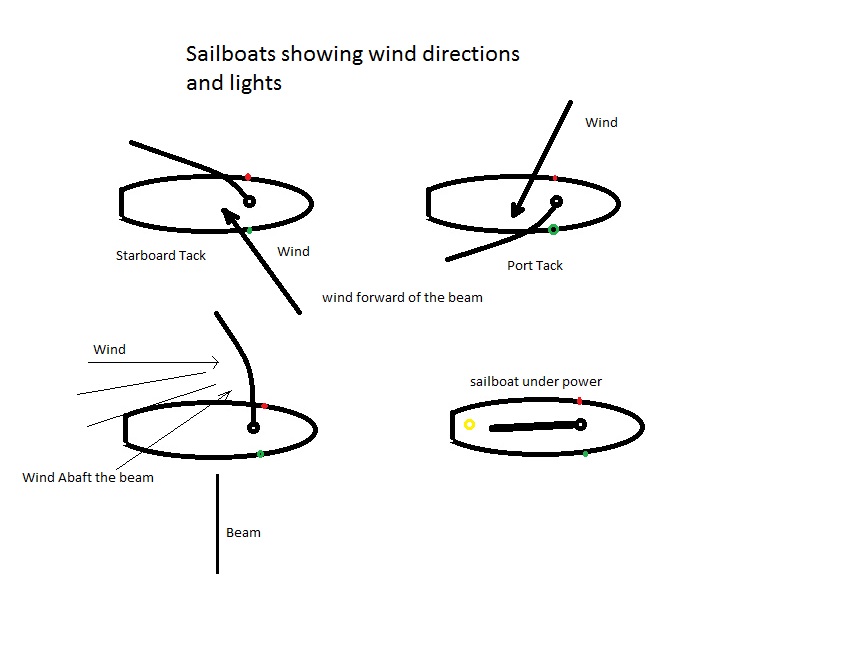 |
 This boat is on a port tack because the wind is coming over the port side. |
a. If both vessels are tacking up wind, the boat that is on the starboard tack (the wind is coming over the starboard side) is the stand on vessel.
b. If both sailboats are on the same tack, the sailboat to leeward (downwind) is the stand on vessel.
c. If one vessel is tacking up wind, and the other is sailing down wind, that is, has the wind abaft (behind) the beam (right angles to the boat), then the boat going upwind is the stand on vessel.
d. If both vessels are sailing with the wind abaft the beam (downwind) then the vessel being overtaken is the stand on vessel and the overtaking vessel is the give way vessel and must stay clear.
Powerboats: These rules apply to any vessel under power whether it is a large power yacht, small outboard boat, sailboat under power, or a dinghy with a small engine. Anything under power.
Overtaking vessels: If a boat is being overtaken by another boat, the boat being overtaken is the stand on vessel and must maintain course and speed. The other vessel is the give way vessel and must stay clear while passing.
Crossing vessels: If two boats are on courses that will require one to cross the course of the other, the boat that is to your starboard (right) side is the stand on vessel. The other is the give way vessel and must alter course and speed if there is danger of a collision. This is determined by what is called the danger zone. The danger zone is an arc, starting straight ahead and ending to your starboard (right side) at 112.5 degrees aft of forward. So if you point straight ahead with your left arm and straight out to the side with your right arm and the boat is forward of your right arm but behind straight ahead, then you have to avoid the other boat. See picture below
Meeting. Two boats meeting on opposite courses, that is head to head, are both give way, and must avoid each other. Generally they both turn to starboard (the right) to allow room to pass, unless they exchange signals indicating they will turn to port. Later, I will briefly cover signals.
The above are covered in Rules 11 Through 18 of the Navigation Rules: For more see: http://navcen.uscg.gov/?pageName=navRulesContent
Navigation Lights: See also https://newboatbuilders.com/pages/navlts.html
All boats and ships underway at night are required to show lights. These lights are not only to show your position, but to show the direction you are traveling, how fast you are moving, and by their configuration what type and size of vessel you are operating. So there is much more to navigation lights than just "are they on" .
Small boats under manual propulsion and
sailboats less than 7 meters (23 feet) in length may show any white light.
A lantern, a flashlight, an all around (360 deg.) light. Any white light! This
means canoes, kayaks, rowboats, dinghies, etc.
 However,
they may show red/green and an all around white light.
However,
they may show red/green and an all around white light.
Other than the above, all boats have to show a red light on the port side and a green light on the starboard side. On a vessel less than 20 meters (65 Feet) in length the red and green may be combined into one lantern on the bow. These lights should show in an arc from dead ahead, aft to 112.5 deg. on either side. Slightly more than a right angle. There must be a white masthead light and a white stern light but on some boats this may be combined into one all around white light. This all around light must be at least one meter higher than the red and green lights. This is what is most often seen on small outboard and inboard motorboats, and for most people who do their boating on small lakes and rivers, this light configuration is the only one they will ever see.
For sailing vessels under 20 meters (65.6 feet) in length this is all they are required to show. The red and green can be combined in one lantern at the bow. The masthead light is usually at or near the top of the mast (the rules do not say which mast). These three lights can be combined into one lantern at the top of the mast.
The rules regarding lights, shapes, bells and whistles are in Parts C and D, Rules 20 Through 37 http://navcen.uscg.gov/?pageName=navRulesContent