
GASOLINE FUEL SYSTEMS
Page 2 of 2 - Return to Page 1
Safety regulations and standards for gasoline fuel systems on recreational boats.
More on Fuel Systems: 33 CFR 183.501-590
Carburetors: Carburetors must be of a marine type. Again this is because you don't want fuel spilling into the boat. So, if the carburetor floods or the float sticks it must be designed to keep the excess fuel from flowing out of the top of the carburetor through a vent or other opening. Use only a marine type carburetor! Yes, they cost more. Yes, they look just like an automotive carburetor. But, they are different inside, and the difference can save your life. See Marine Engines 101
Flame Arrestors: See Title 46 CFR Chapter I Part 58 Internal Combustion Engine Installations
33 CFR 183.505: Flame arrestor means a device or assembly that prevents passage of flame through a fuel vent.
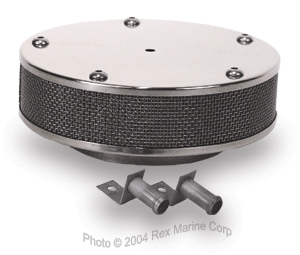
Marine Carburetors and Fuel Injection systems must have a flame arrestor installed to prevent a back fire from igniting fuel vapor in the engine compartment. If the air induction system is in itself a flame arrestor, or if a backfire would be directed outside the boat and away from the passengers or interior of the boat then the flame arrestor is not required. Some fuel injection systems and ram air induction systems meet this last part, but most don't. If you are worried about the engine getting enough filtered air, there are flame arrestors on the market that also act as filters. Here is an example: https://www.knfilters.com/search/Marine,%20Filter,%20Flame%20Arrestor
This is a safety regulation that has been around since the Motor Boat Act of 1940. Marine gasoline engines have not always been as sophisticated and reliable as they are now, and were often going out of tune. So a means was needed to prevent explosions from engines that backfired. Here are examples of typical flame arrestors, one from my own boat, a 1972 Sea Ray, and a modern unit.
 |
 |
Prior to 1991 Flame Arrestors had to be USCG Approved. But since there are excellent industry standards for flame arrestors the U S Coast Guard changed the requirement so that you could use either USCG approved units or those that meet SAE or UL standards.
(3) The following are acceptable means of backfire flame control for gasoline engines:
(i) A backfire flame arrester complying with SAE J-1928 or UL 1111 and marked accordingly.
Fuel Pumps: 33 CFR 183.524 and 183.566
Fuel pumps must be mounted on the engine or within 12 inches of the engine. This is to keep the amount of pressurized fuel line as short as possible. It is a bad situation to have long fuel lines that are under pressure snaking through the boat. If you get a leak they will dump all of the contents of the line into the boat. The shorter the line the less fuel that will be spilled.
If they are not mounted on the engine they must be securely mounted to the boat structure to prevent the fittings from loosening, and they cannot put any strain on the fuel line. Fuel pumps cannot be supported by the fuel line.
Fuel pumps cannot leak into the boat, so if you have an engine that uses a mechanical fuel pump it has to be a double diaphragm pump or have some other means to keep the fuel from leaking into the boat. The pump must be capable of passing the 2 1/2 minute fire test.
Electric fuel pumps can only operate when the engine is running.
The exception to this is on fuel injected engines. Fuel injected engines require the line to the fuel rack to be pressurized for the engine to start. The pump is allowed to come on momentarily to pressurize the line. This is not the entire fuel line, it is only the line from the pump to the fuel rack. Then the pump shuts off until the engine starts.
Pump In Tank Fuel Systems
ABYC has updated it's standard H-24 Gasoline (Petrol) Fuel Systems, to allow for systems that have the fuel pump inside the tank. The USCG is accepting this as an equivalency under some situations, but you need to consult with the Coast Guard and make sure you comply with all the conditions of the ABYC Standard. It is in H-24.17 Fuel Distribution and Return Systems.
It includes the following:
All fittings must be readily accessible, or have a port or opening which allows access.
Fuel distribution and return lines shall be seamless copper, nickel copper, or copper nickel with a minimum wall thickness of 0.029 in (0.74 mm) [nominal 0.032 in (0.8 mm)], or 24.17.2.1 shall be flexible fuel hose identified as USCG Type A1-15 if the line is within an engine compartment (see TABLE 1).
All Fuel Distribution lines inside the engine compartment must be USCG type A1-15, or under certain circumstances listed in ABYC 24.17.3.2 B1-15 is allowed.
There are other requirements. Contact ABYC and obtain a copy of Standard H-24 Gasoline (Petrol) Fuel Systems.
Fuel Stop Valves: 33 CFR 183.528 (shutoff valves) They must meet the same fire test as other fuel fittings. If they are electric they can only operate when the ignition switch is on and they must be able to be operated manually.
Fuel Filters and Strainers: 33 CFR 183.534
Filters and Strainers must also be capable of passing the 2 1/2 minute fire test. They must be securely mounted on the engine or boat structure. This mounting must be independent of the fuel line. In other words, the filter or strainer can not be putting any strain on the fuel line. The only exception is a filter inside a fuel tank.
Seals and gaskets in fuel filters and strainers:
b) Each gasket and each sealed joint in a fuel filter and strainer must not leak when subjected for 24 hours to a gasoline that has at least a 50 percent aromatic content at the test pressure marked on the fuel tank label.
To put it simply, these seals and gaskets must be resistant to gasoline, and that includes gasoline with ethanol.
When you purchase filters and strainers, or for that matter any fuel system component, check the specifications. Does this item comply with 33 CFR 183.534? Is there a label on the packaging that say it does, or says it complies with USCG requirements? Some filters may have glass bowls, or plastic windows that do not pass the fire test. Never use those plastic in-line automotive filters often seen on older cars. They do not comply with this requirement. I have seen these on boats, usually installed by tbe boat owner. They have been the source of fuel leaks and fires.
Content Continues After Ad
Clamping Fuel and Vent Hose:
Belief: All fuel system hose must be double clamped: Not True: 33 CFR Subpart J Gasoline Fuel Systems
Sec. 183.558 Hoses and connections.
(b) Each hose used—
(1) For a vent line or fill line must be: ..........
(c) Each hose must be secured by:
(3) A hose clamp.
The USCG regulation says that hoses on the fuel fill system must be double clamped, but they are silent on whether or not the vent line must be double clamped. The rule has always been, if it's not prohibited or required then it's allowed. So vent lines may be single clamped. The ABYC standard H-24 Gasoline Fuel Systems, only requires the vent to be single clamped. But I have always recommended double clamping. It is just as disastrous to have a vent line come loose, as it is for a fill line.
ABYC H-24 Gasoline Fuel Systems 24.12.9;
Hose connections used in the fuel tank vent system or the fuel distribution and return line system shall have at least one corrosion resistant metallic clamp with a minimum nominal band width as indicated in H-24 TABLE III."
So vent lines may be single clamped. But I recommend you double clamp if possible for an extra measure of safety. Unfortunately some of the vent fittings on the market are not long enough for double clamping, so when you buy your fittings look for ones that are long enough.
Clamps: 33 CFR 183. 532 If you use clamps, they must be used with hose designed for clamping. Sounds pretty obvious doesn't it. They must be placed beyond the bead, flare, or over the serrations of the mating spud, pipe, or hose fitting; and, not depend solely on the spring tension of the clamp for compressive force. Again this is pretty obvious stuff. In addition, the law doesn't require it but ABYC standards and good practice require that clamps be at least ½ inch wide, and each hose should be double clamped.
Clamps must be a corrosion resistant material. Use 316L stainless Steel. But be careful. Many stainless steel clamps do not have stainless steel screws that tighten them. Make sure you specify that the screw be stainless also.
Some hoses are not designed for use with clamps. For instance Aeroquip racing hose has permanently installed end fittings. You do not use clamps with these hoses.
Fuel Fittings: 33 CFR 183.588 If you don't use clamps, but use fittings instead they must be:
A swaged sleeve;
A sleeve and threaded insert.
Accessibility: 33 CFR 183.554 This is self explanatory.
Sec. 183.554 Fittings, joints, and connections. Each fuel system fitting, joint, and connection must be arranged so that it can be reached for inspection, removal, or maintenance without removal of permanent boat structure.
References:
33 CFR Subpart I: Fuel Systems USA Recreational Boat Fuel System Regulations
TP 1332: CONSTRUCTION STANDARDS FOR SMALL VESSELS Section 7 Fuel Systems Canada Standards for small craft.
ABYC H-24 Gasoline Fuel Systems
| <<Back to Fuel Systems Page 1 | Fuel Systems - Marine Engines>> |
|
|
|
This Web site may contain copyrighted material the use of which has not always been specifically authorized by the copyright owner. I am making such material available in my efforts to advance understanding of educational, economic, and scientific issues, etc. I believe this constitutes a "fair use" of any such copyrighted material as provided for in section 107 of the US Copyright Law. In accordance with Title 17 U.S.C. Section 107, the material on this Web site is distributed without profit to those who have expressed a prior interest in receiving the included information for nonprofit educational purposes. For more information see: www.law.cornell.edu/uscode/17/107.shtml. If you wish to use copyrighted material from this Web site for purposes of your own that go beyond "fair use", you must obtain permission from the copyright owner. |