

BASIC FLOTATION
Flotation standards for sterndrive and inboard powered recreational boats. 33 CFR 183.101-105
Applies to:
Monohull Boats (not catamarans, trimarans, or pontoon boats): Mono-hull means that if you can draw a continuous line around the hull at the waterline when the boat is at rest it's a monohull. If it makes two or more footprints in the water it's a multi-hull.
With inboard engines (gas, diesel, electric, stern-drive, etc.):
Less than 20 feet (measured on the center line, including rub rails):
This category includes most stern-drive and inboard motor boats.
Electric boats must follow the same requirements for foam as that for gas powered boats.
Standards for Electric Propulsion boats, for Flotation, Safe Loading and Maximum Horsepower Ratings.
The U.S. Coast Guard has published a policy letter regarding standards for Flotation, Safe Loading and Maximum Horsepower ratings on boats with electric propulsion. Essentially the policy letter says that manufacturers of electric propulsion recreational boats should comply with the same standards for Safe Loading, Flotation, and Safe horsepower as gasoline powered recreational boats, and refers to ABYC Standard E-13 Lithium Batteries and E-30 Electric Propulsion Systems for Boats with Electric Propulsion. The policy letter can be seen at the Coast Guard's website at https://safeafloat.com/wp-content/uploads/2022/08/BSX-23-Electric-Propulsion-Policy-FINAL.pdf
Requirements:
The boat has to float when swamped, (that is; full of water), with some part of the boat out of the water.
So how do I know how much flotation to put in the boat?
The amount of flotation is based on three factors.
1. The boat weight: that is the weight of the hull, the deck, the seats, etc. Everything not in the next two categories.
2. The machinery weight; engines, batteries, full fuel tank, and controls.
3. The weight of the persons. This comes from the persons weight on the capacity label.
Go to page on how to calculate amount of flotation.
What do I use for flotation?
Most people use polyurethane foam. Some use polystyrene foam. If you use polystyrene foam you must install it in a way that it cannot be attacked by gasoline, oils or bilge cleaners. See 33 CFR 183.112-114 on flotation materials. Others use air chambers. Air chambers that are integral with the hull are not allowed. They must be separate from the hull. Also, you have to pass the test with the two largest chambers punctured. Foam is a good solution, but some don't want foam in their boats. In that case they can use balsa, or build air chambers into the boat. The two main reasons boats fail is not enough flotation, and not enough flotation to support the engine.
How do I know it works?.
Test it!
The best way to find out if your boat passes is to test it. You can do the test yourself, or have a laboratory do it. However, as of June 2014 the USCG Voluntary testing program has ended. The Coast Guard will no longer test your boat for free. You will have to pay the laboratory to test the boat for you. Call the Coast Guard at or 202-372-1077 to find out about the test program. The Coast Guard still purchases and test boats they suspect are not in compliance and cannot pass the flotation requirements. If this happens you will have to do a recall on all boats of that year and model, so it is better to test it before you start selling them.
Here's how it's done.
You need to know the following:
The maximum weight capacity ( the safe load ) your boat will carry.
How much weight in people it will carry
The machinery weight.
There are some things you also need to know before you do the test. What kind of weights will you use for the test? The test lab uses iron ingots. You can use anything that does not absorb water, which leaves out concrete or concrete blocks. You also need to weigh each of the weights with a calibrated industrial scale. These can be rented from companies that rent equipment for labratories.
You need to determine if the test weights will be submerged or dry. In the capacity tests the weights are dry, but in the flotation test they will most likely be submerged. Submerged they weigh less than they do dry. This is not difficult to calculate. The USCG, and ABYC publish tables of factors (determined from the specific gravity of the weight) for different materials. For iron the factor is 0.86. That is you need to add weight for iron, because under water it weighs less. For example if the amount of weight needed is 200 lb., you need to add 33 lbs to compensate for it's reduced weight underwater. (200/0.86 = 232.5 dry weight)
The table for the factors is at https://newboatbuilders.com/pages/factors.html
Most inboard boats have a permanently installed fuel tank, you need to test it as if the tank were full. On some boats the tank may be high enough to be dry when the boat is full of water. But on most boats it is submerged. .
The USCG recommends you do not test the boat with gasoline in the tank. This could result in environmental issues, and safety issues. Test the boat with the tank empty, preferably before the tank has ever been filled. You could put water in the tank and compensate for the difference in weight between water and gasoline. (Gasoline is about 6 lb per gal, fresh water is about 8 lb per gal). But then you can have difficulty getting all of the water out of the tank. So it is best to test it empty.
You need to calculate the weight of the tank as full, and then determine what the weights would weigh submerged. For instance if it is a 40 gallon tank, and you are using iron weights then:
240lb/0.86 = 279 lbs. or you can use the formula the USCG uses, 40 gals times 7.1523 = 286 lbs. I recommend you use the Coast Guard formula.
Then measure the following on your boat:(Click image for full size) Cockpit area. 40% reference area. Passenger area 70% reference areas. Two foot reference areas fore and aft.
|
 |
Load the boat with
2/15 of the Person Capacity.
25% of the Dead Weight.
Dead Weight = Maximum Weight Capacity - Persons Weight
(this figure can be zero or negative. If negative use zero)
62.4 times the volume of the 2 largest air chambers, if you used air chambers, or puncture and flood the two largest air chambers.
With this weight aboard and the boat fully swamped, it must float with some part of the boat out of the water.
ABYC H-8.7.3.1.2, SAYS THAT IN ADDITION TO THE ABOVE: “WEIGHTS THAT, WHEN SUBMERGED, EQUALS 75% OF THE DRY WEIGHTS OF THE PROPULSION SYSTEM AND BATTERIES."
ABYC assumes you will test without the engines and sterndrive installed. The Coast Guard tests the boat with the engines installed but removes the sterndrive and batteries, and substitutes weights.
Initially the boat is flooded with water and allowed to soak for 18 hours. Then the weights for the basic flotation test are added, and if any part of the boat is above the water it passes. Reality: The reality of this test is that with most inboard boats the boat will float with only the bow sticking out of the water. If you can, try to achieve better than that. But it is difficult to provide enough flotation aft to float the weight of the engine. |
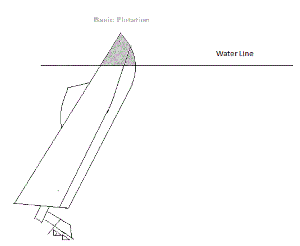 |
Typically the test tanks are not deep enough to accurately test a boat with basic flotation. So weights have to be shifted around to make the boat float in a more level attitude. Try to install the flotation in the area around the engine.
That's It! If you pass all these tests you have done everything the regulations require.
The most common reasons for failing the flotation Test;
Not enough flotation:
Incorrect flotation foam density: The calculations use 2lb density. That is, one cubic foot of foam weighs 2 lb. If you use heavier (or lighter) you will fail unless you actually use a denser or lighter foam and use it's density in the calculations:
Improper kind of foam in the bilge: Flotation foam that is resistant to exposure to gas, oils, bilge cleaners, or anything that can dissolve or damage the foam, is usually polyurethane. But some manufacturers use polystyrene foams, the most common of which is Styrofoam (a trademarked name). Stryofoam, and all polystyrene foams, will be dissolved by gas, oils, bilge cleaners, etc. They must not be used in the bilge or anywhere they can be exposed to those solvents unless encapsulated so they can't be contacted.
|
|
|
This Web site may contain copyrighted material the use of which has not always been specifically authorized by the copyright owner. I am making such material available in my efforts to advance understanding of educational, economic, and scientific issues, etc. I believe this constitutes a "fair use" of any such copyrighted material as provided for in section 107 of the US Copyright Law. In accordance with Title 17 U.S.C. Section 107, the material on this Web site is distributed without profit to those who have expressed a prior interest in receiving the included information for nonprofit educational purposes. For more information see: www.law.cornell.edu/uscode/17/107.shtml. If you wish to use copyrighted material from this Web site for purposes of your own that go beyond "fair use", you must obtain permission from the copyright owner. |



Advertisement